Rebar Splicing Fundamentals
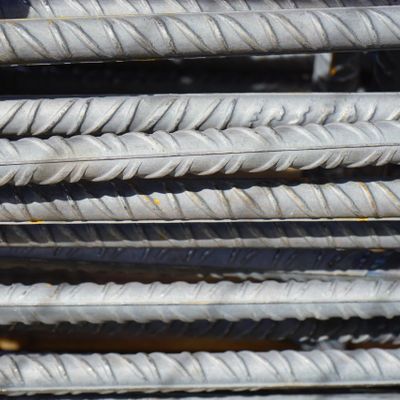
Understanding Rebar Splicing
Reinforcing bar (rebar) splicing is the process of creating a continuous load path between two reinforcing bars. Splices are required whenever the available bar length is insufficient to achieve the required member length, where construction sequencing demands a connection between two bars or where existing structures are being strengthened, repaired or modified.
A correctly designed and installed splice must develop the full strength of the bars, maintain structural integrity and satisfy code requirements for slip and load transfer. Load transfer may occur through concrete bond, mechanical bearing, thread engagement, metallurgical fusion, or a combination of these mechanisms.
Modern construction utilises a variety of splice technologies, each offering advantages and limitations depending on structural demands, construction methodology, reinforcement congestion, project economics and construction program.
Why Rebar Splicing is Required
Rebar splicing is commonly required for:
- Extending reinforcement beyond available stock lengths
- Joining reinforcement cages
- Column and wall continuity between construction stages
- Pile-to-pile cap connections
- Bridge deck and infrastructure construction
- Closure pours and staged construction
- Precast concrete construction
- Retrofit and strengthening works
- Repair and modification of existing structures
The chosen splice must be capable of transferring the required design forces and must always be designed, specified and installed in accordance with the applicable Australian Standards, Road Authority Specifications and manufacturer's installation guidelines.

The Growing Role of Mechanical Couplers
As structures become taller, more heavily reinforced and increasingly complex, mechanical couplers are rapidly replacing traditional lap splices in many applications. Their ability to develop full bar strength while reducing congestion, minimizing steel consumption and improving constructability has made them the preferred solution for many modern structural and infrastructure projects.
Mechanical couplers transfer load directly between reinforcing bars through a mechanical connection. Unlike lap splices, mechanical couplers do not rely on concrete bond to transfer force.
Among mechanical splice technologies, FORTIS Bolt Couplers offer a particularly versatile solution because they eliminate the need for threading, welding, bar-end preparation and advance rebar scheduling, making them exceptionally well suited to both new construction and retrofit applications.
Splice Load Transfer
All types of rebar splice systems perform the same fundamental function—transferring force from one reinforcing bar into another. However, the mechanism by which this occurs varies considerably.
- Bond-Based Transfer: Used in lap splices, force is transferred through bond stresses developed between the reinforcing bar and surrounding concrete.
- Mechanical Transfer: Used in mechanical couplers, force is transferred directly through bearing, friction, interlock or thread engagement within the coupler itself.
- Metallurgical Transfer: Used in welded lap and friction-welded systems, force is transferred through a metallurgical bond created between the reinforcing bars.
Understanding the force transfer mechanism is critical when selecting the most appropriate splice solution for a particular application.
Types of Rebar Splices
Lapped Splice
Welded Lap Splice
Welded Lap Splice

The lap splice is the oldest and most widely used form of rebar splice. Two bars are placed alongside one another over a specified lap length and force is transferred indirectly through bond stresses between the steel and surrounding concrete.
The bars themselves never directly transfer load to one another.
Welded Lap Splice
Welded Lap Splice
Welded Lap Splice
Two bars are placed alongside one another (over a shorter length than with a lapped splice) and are welded together to develop the full strength of the bars. This is often used in prefabrication yards, however is permitted on site when completed by qualified welders to code requirements.
Threaded Splice
Welded Lap Splice
Swaged Coupler Splice
Bars are joined together using a threaded coupler providing a mechanical connection through direct tension in the threads. The ends of the bars can either be equipped with a parallel male thread or a tapered male thread, with matching female threaded couplers used to connect the bars. This splice requires proprietary off-site bar end preparation.
Swaged Coupler Splice
Friction Welded Coupler Splice
Swaged Coupler Splice
This is similar to the threaded splice, where the bars are joined together using a threaded coupler, however this system relies on a steel sleeve being hydraulically deformed onto reinforcing bars.
The sleeve plastically deforms around the bar profile, creating a permanent mechanical interlock. These systems typically consist of a male threaded coupler on one bar and a female threaded coupler on the opposing bar. This splice requires proprietary off-site bar end preparation.
Friction Welded Coupler Splice
Friction Welded Coupler Splice
Friction Welded Coupler Splice
This is similar to the threaded splice, where the bars are joined together using a threaded coupler, however this system relies on the threaded coupler itself being attached to the bars by friction welding. Friction welding is a factory-controlled process in which one component rotates at high speed while being pressed against another.
The generated heat produces a solid-state metallurgical bond without melting the steel.
These systems typically consist of a male threaded coupler on one bar and a female threaded coupler on the opposing bar. This splice requires proprietary off-site bar end preparation.
FORTIS Bolt Coupler Splice
Friction Welded Coupler Splice
Friction Welded Coupler Splice
FORTIS Bolt Couplers work by using torque-controlled lock-shear bolts to clamp and mechanically interlock two reinforcing bars inside an internally-threaded steel sleeve. Tensile forces are transferred from the first bar through the bolt indentations in the rebar and internal threads of the coupler sleeve into the coupler sleeve itself. This system is ideal for applications where it is not practical to have the ends of the rebar prepared off-site. or when final bar geometries are not known until bars are being cast on site. This splice requires no off-site bar end preparation, nor advance rebar scheduling
Rebar Splice Comparison (Click to Enlarge)


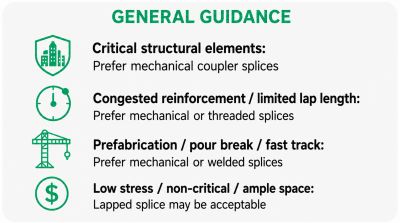
Which Splice Type is Right for My Application?
The selection of a rebar splicing system for your project should consider structural, construction, economic and program factors. These considerations include, but are not limited to:
- Design Requirements: Tensile and yield strengths, uniform elongation and slip limits.
- Member Size and Congestion: Available space for rebar laps and/or installation tools.
- Construction Method: Cast-in-place, precast, formwork cycle times.
- Bar Size and Grade: Compatibility with your chosen splice system.
- Concrete Quality and Cover: These attributes influence bond and durability.
- Project Criticality and Risk: Importance of reliable, predictable performance.
- Construction Program: Is there sufficient time to implement your chosen system?
Regardless of the type of rebar splice selected, always design, specify and install rebar splices in accordance with the applicable Australian Standards and manufacturer's installation guidelines. Relevant Australian Standards include, but are not limited to:
- AS3600:2018 Concrete Structures
- AS 5100.5:2017 Bridge Design, Part 5: Concrete
- AS/NZS 4671:2019 Steel for the Reinforcement of Concrete
- AS/NZS 1554.3:2014 Structural Steel Welding, Part 3: Welding of Reinforcing Steel
- Road Authority Specifications relevant to your jurisdiction
.jpg/:/cr=t:28.58%25,l:21.18%25,w:56.18%25,h:42.04%25/rs=w:1209,h:549,cg:true,m)
Welcome to STRYPE.
We have just launched our new website and we hope you love it as much as we do. If you have any trouble navigating the website, we would love you to share this feedback with us so that we may further enhance your experience.