FORTIS Bolt Couplers
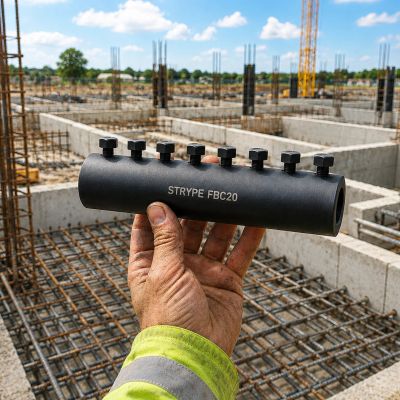
What are FORTIS Bolt Couplers?
FORTIS Bolt Couplers are high-performance mechanical couplers designed for the joining of AS/NZS 4671:2019 Grade 500N rebar from N12 to N40 (inclusive) in applications where it is not practical to have the ends of the rebar prepared off-site.
Designed to deliver exceptional strength, simplicity and reliability, FORTIS Bolt Couplers provide a fast, site-friendly solution for new construction, retrofit and remedial applications.
The bars are locked in place by special lock-shear bolts. The heads of these bolts shear off when the required tightening torque is reached, allowing for visual verification of correct installation.
The performance of these couplers has been verified by destructive testing in Australian laboratories, mitigating the need for complex Engineering calculations.
Testing & Compliance
All FORTIS Bolt Couplers have been independently tested by third-party NATA-Accredited Australian laboratories to demonstrate compliance with relevant Australian standards and Road Authority Specifications when used with AS/NZS 4671:2019 Grade 500N reinforcing bar.
All FORTIS Bolt Couplers meet or exceed the following standards and specifications:
- Transport for New South Wales Document No. SF2013/184115 , Issue 4, October 2022
- VicRoads Bridge Technical Note BTN 025, Version 2.1, published 3 October 2022
- AS3600:2018 Concrete Structures, Clause 13.2.6: Welded or Mechanical Splices
- AS 5100.5:2017 Bridge Design, Part 5: Concrete
- AS/NZS 4671:2019 Steel for the Reinforcement of Concrete
- ISO 15835-1:2018 Steels for the Reinforcement of Concrete - Reinforcement Couplers for Mechanical Splices of Bars, Clause 5.3: Strength and Ductility Under Static Forces & Clause 5.4: Slip Under Static Forces
Further details regarding compliance of the FORTIS Bolt Coupler system may be provided on request.

Available Sizes
FORTIS Bolt Couplers are offered in eight (8) sizes to suit all standard sizes of AS/NZS 4671 Grade 500N reinforcing bar, from N12 to N40 (inclusive).
Each coupler is uniquely designed to optimise strength while minimising installation complexities, with attributes such as length, diameter, bolt quantity and bolt sizing all varying by coupler size.
Details of the available FORTIS Bolt Couplers are accessible in the FORTIS Bolt Coupler Product Brochure.
Common Applications
FORTIS Bolt Couplers provide a cost-effective method of joining rebar on site, particularly when one bar is already in place or when bars are unable to be rotated on site. Common applications include, but are not limited to:
- Extending reinforcement beyond available stock lengths
- Joining reinforcement cages
- Column and wall continuity between construction stages
- Pile-to-pile cap connections
- Bridge deck and infrastructure construction
- Closure pours and staged construction
- Precast concrete construction
- Retrofit and strengthening works
- Repair and modification of existing structures (remedial applications)

Performance
FORTIS Bolt Couplers work by using torque-controlled lock-shear bolts to clamp and mechanically interlock two reinforcing bars inside an internally-threaded steel sleeve. Tensile forces are transferred from the first bar through the bolt indentations in the rebar and internal threads of the coupler sleeve into the coupler sleeve itself. The sleeve then transfers the load through the adjacent bolts and internal threads of the coupler sleeve into the second bar, creating a structural rebar splice without threading, welding, or bar rotation.
In line with Transport for New South Wales requirements, which nominate the most stringent specification for rebar splicing systems in Australia, beyond what is nominated in AS3600:2018 Concrete Structures, AS 5100.5:2017 Bridge Design, Part 5: Concrete and any other Road Authority specification in Australia, the tensile strength of FORTIS Bolt Couplers exceeds 625MPa and 97.5% of the tensile strength of the parent rebar, along with achieving a slip performance of less an 0.1mm.
The mechanical properties of the spliced rebar, including tensile strength, yield strength and uniform elongation are compliant with the requirements of AS/NZS 4671: 2019 - Table 7.2 (A) for Strength Grade and Ductility Class 500N.

.jpg/:/cr=t:28.58%25,l:21.18%25,w:56.18%25,h:42.04%25/rs=w:1209,h:549,cg:true,m)
Welcome to STRYPE.
We have just launched our new website and we hope you love it as much as we do. If you have any trouble navigating the website, we would love you to share this feedback with us so that we may further enhance your experience.